

Measure what matters
Evaluating the impact of your actions


Why measuring impact is essential.
You've launched inclusion initiatives, invested in EDI training, and revised your policies. But how do you know if it's actually working?
Measuring sustainable change in workplace culture can feel difficult, but it's essential for driving real progress. Without the right evidence, you're navigating your change journey without a compass.
To create lasting transformation, you need to focus on the changes that truly matter - not just diversity statistics, but the real shifts in employee experience, organisational culture, and workplace behaviours that signal genuine progress toward inclusion.

The power of
evidence-based inclusion.
Measuring the impact of your inclusion actions gives you the evidence you need to make informed decisions. It reveals what's working well and where challenges persist, helping you refine your approach for maximum effectiveness. This evidence doesn't just validate your efforts - it demonstrates your commitment to creating an inclusive workplace and provides the foundation for a robust, data-driven inclusion strategy.
Our inclusion impact evaluation helps you understand the true effectiveness of your initiatives, giving you a clear picture of where you stand and actionable insights for continuous improvement. We provide meaningful indicators of impact that track real changes in behaviours and attitudes across your workforce, so you can monitor and evidence your transformation as you become more diverse and inclusive.

Effective measurement helps you to:
Align with strategic goals
Ensure your inclusion efforts support broader organisational objectives while prioritising workforce wellbeing and driving accountability.
Identify what's working
Pinpoint which initiatives are delivering results and which need adjustment to maximise impact.
Address persistent challenges
Spot where barriers remain so you can adapt your approach strategically.
Celebrate and amplify success
Recognise achievements, share stories of positive change, and reinforce your commitment to inclusion across the organisation.
Our research-backed framework.
Over the past decade, we've focused our research on developing sustainable inclusive environments and building workforce diversity. This work has given us deep insight into how organisational change happens and, critically, how to measure that change effectively.
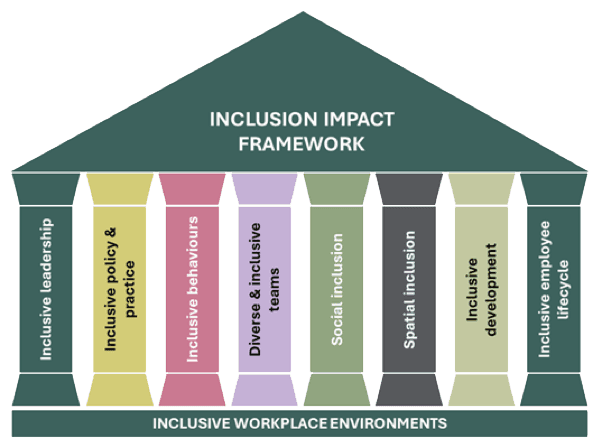
Our inclusion impact framework connects inclusion interventions directly to indicators of change, including shifts in attitudes and behaviours across your workforce. This framework gives you practical tools to measure your progress toward genuine workplace inclusivity.

How the framework works
We use five types of change indicators, defined at three operational levels to capture the full picture of your inclusion journey:
Change indicator types
Knowledge and understanding
What people know
Skills and behaviour
What people can do and actually do
Attitudes
What people believe
Operational levels
System-wide changes
Leadership-level shifts
What we actually measure
We go beyond surface-level metrics to assess the indicators that truly reflect workplace culture. Here are some of the key measures we track:
Sense of belonging
A sense of belonging − the perception of being accepted within a given group − is an important measure of the maturity of your journey to inclusion, and a key indicator of workplace inclusivity.
Psychological safety
Psychological safety − shared belief that the workplace is safe for interpersonal risk taking, such as speaking up against a popular idea − goes hand-in-hand with inclusion and can be used as an indicator of workplace inclusivity.
Perception of bullying & harassment
Workplace environments that support inclusion reduce the likelihood of bullying and harassment. Perception of bullying and harassment is an important indicator of workplace inclusivity.
Confidence & self-efficacy
Confidence and self-efficacy, crucial for individuals to feel empowered to participate fully in the workplace, and to share their ideas, opinions and perspectives, are important indicators of workplace inclusivity.
Organisational climate
Organisational climate − the collective perception of the employees about the work environment − can be used as a holistic indicator of workplace inclusivity.
Diversity
Building inclusive and supportive workplace environments with inclusive policies, practices and behaviours provides the key ingredients for diversity to grow. As such, diversity can be used − carefully − as an indicator of inclusion.